Most people who ask us for a catamaran picture the same boat: two hulls, a mast, sails, a trampoline at the bow. That is a sailing catamaran. But a growing part of the crewed catamarans in Greece have no mast at all. They are power catamarans, and the difference matters more than the photos suggest.
Two hulls, two ways of moving
A crewed sailing catamaran sails when the wind is right and motors when it is not. She is built for the pleasure of a slower week: quiet afternoons under sail, long stays at anchor, the motion of a sailing boat. Most cruise at around 7 to 9 knots.
A power catamaran is a motor yacht on two hulls. No mast, no sails, two engines, and usually a large flybridge where the boom and rigging would be. Depending on the model she cruises at around 11 to 16 knots, sometimes more. You keep the stability and the space of a catamaran and gain the pace of a motor yacht.
What changes on board
- Space: without a mast and rigging, the flybridge and foredeck become living space. A power catamaran of 16 to 19 metres often feels as roomy as a much longer motor yacht.
- The week itself: on a sailing catamaran the sea sets the pace. On a power catamaran you can see more islands in the same week and move on quickly if the weather turns.
- Fuel: a power catamaran uses more fuel than a sailing catamaran, so the APA is usually higher. Modern hulls are efficient for their size, and we always set the fuel out in the proposal.
- Crew: both come with a permanent crew of at least two, usually a captain and a hostess or chef, and three or four on the larger boats.
- The feeling: some guests want to sail, to hear the engines go off and the boat heel slightly into the wind. For them, nothing replaces a sailing catamaran. Others never look at the sails at all, and they are happier on a power catamaran.
Families, small children and seasickness
Every catamaran, sail or power, has lower decks than a motor yacht, smooth surfaces that can be slippery when wet, and wire guard lines rather than solid rails. They are perfectly fine for families with children of an age to be careful, with parents keeping an eye on them. For very young children we usually suggest a motor yacht or a motor sailer instead.
If someone in the group suffers from seasickness, the slower passages of a sailing catamaran are not ideal. A power catamaran spends less time on each passage, but a motor yacht or a motor sailer is usually the more comfortable choice. Tell us early and we will take it into account.
Three power catamarans in our selection
- Explorion, a 16 metre Aquila from 2023, for up to 8 guests in four cabins, with a 16 knot cruise and a crew of three.
- Seabarit LX Moon 60, an 18 metre Moon from 2024, for up to 10 guests in five cabins, with solar panels on the hardtop and one of the largest sundecks in her category.
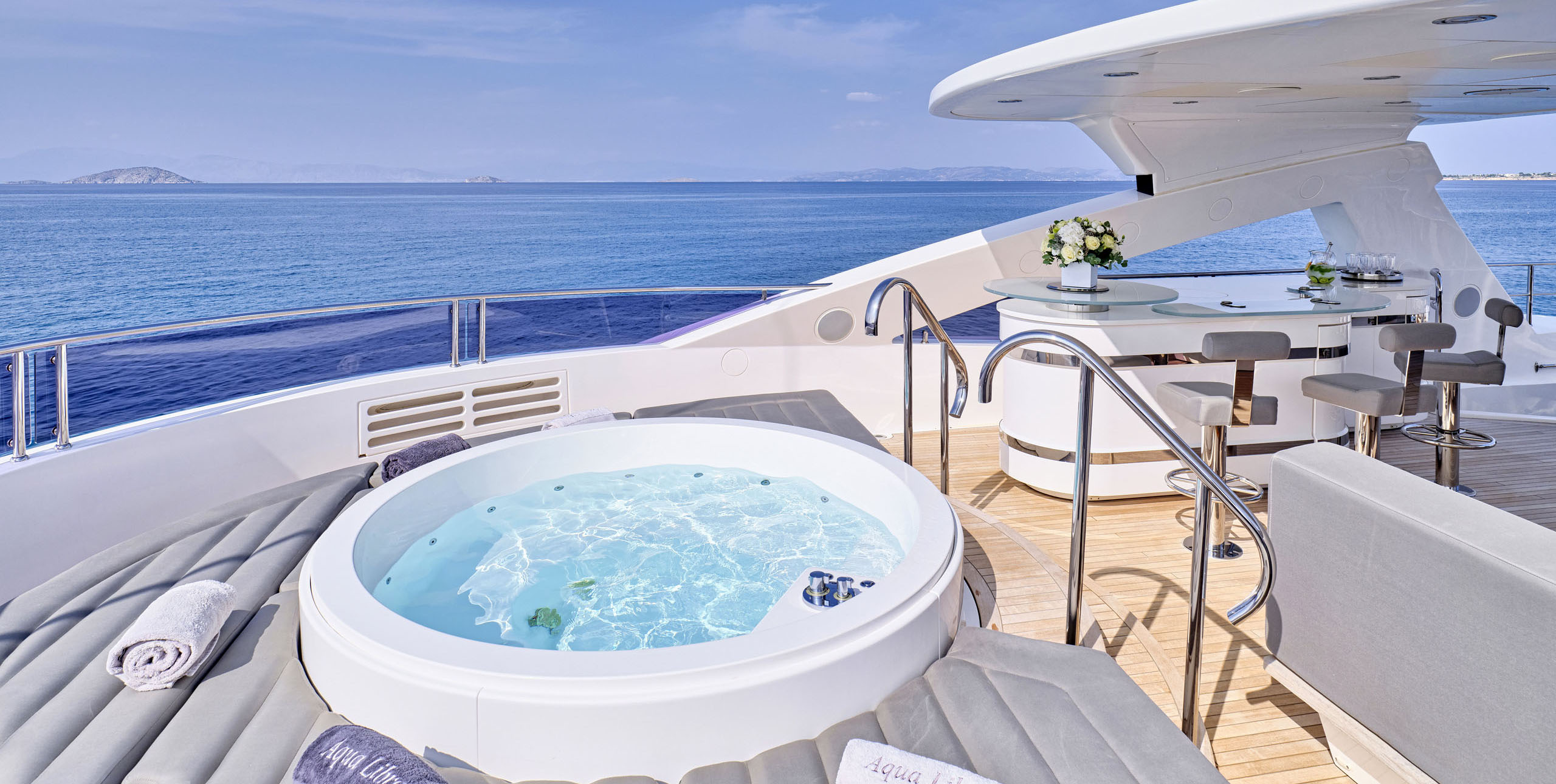
- A Fountaine Pajot 66 from 2024, for up to 8 guests, the most luxurious catamaran we propose, with a jacuzzi on the foredeck and a crew of four.
How to choose
Ask yourselves one question: do you want to sail, or do you want to arrive? If the sailing is part of the holiday, choose a crewed sailing catamaran. If what matters is the islands, the space on deck and the freedom to change plans, a power catamaran will suit you better. And if neither is quite right for your group, we will tell you that too.
All rates are indicative and quoted per week plus all expenses: the APA, VAT at the percentage that applies to each yacht, and an optional gratuity. See what a charter really costs, or send us your dates and the number of guests.